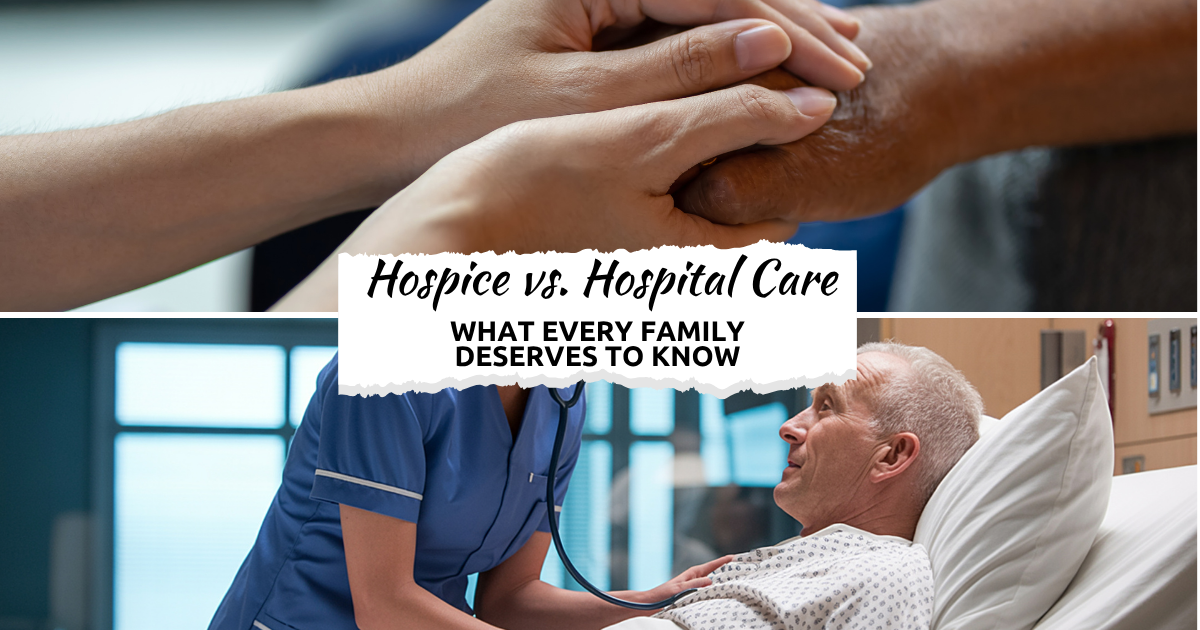
Nearly 1.7 million Americans receive hospice care each year, according to the National Hospice and Palliative Care Organization — yet the families who sit across from us in our arrangement room often tell us they wish they had called hospice sooner. Many of them simply didn’t understand what it was, or they confused it with a hospital stay and assumed it would feel the same: sterile, rushed, and focused on aggressive treatment. If you’re trying to understand hospice care right now — whether for a parent, a spouse, or yourself — this article is for you. We want to walk you through exactly how hospice differs from hospital care, because understanding that difference can meaningfully change the quality of a person’s final days.
What Is Hospice Care, Really?
Hospice is a philosophy of care as much as it is a medical service. It is designed for patients who have decided — often after long and courageous conversations with their doctors and loved ones — to stop pursuing curative treatment and instead focus on comfort, dignity, and quality of life. That decision is never easy, and it is never a sign of giving up. In our experience, it is often one of the most profoundly loving choices a family can make together.
The medical term for what hospice provides is palliative care — meaning care aimed at relieving pain and managing symptoms rather than curing disease. Hospice teams are specialists in this. They are not there to extend life at any cost; they are there to make the life that remains as full and as comfortable as possible.
Seven Ways Hospice Care Differs From a Hospital Stay
1. The Financial Burden Is Far Lighter
One of the first things families worry about is cost, and rightfully so. A hospital stay — especially a long-term one — can be financially devastating, even for families with solid insurance coverage. Deductibles, co-pays, specialist fees, and medication costs can pile up with stunning speed.
Hospice care works differently. Most patients who qualify for hospice also qualify for the Medicare Hospice Benefit — and this includes many people under 65, because a serious illness or disability may have already made them eligible for Medicare. Once the hospice benefit is certified, there are generally no deductibles and virtually no co-pays. Medications related to the terminal diagnosis are covered. Necessary medical equipment — hospital beds, wheelchairs, oxygen — is typically provided at no cost to the family.
We cannot tell you how many families have told us that hospice removed a weight from their shoulders they didn’t even realize they were carrying. When you are not fighting insurance paperwork and medical bills, you are free to simply be present with the person you love.
2. Care Is Deeply Personalized
In a hospital, a patient may see a rotating cast of physicians, residents, nurses, and technicians — sometimes a dozen different faces in a single day. Hospital staff work incredibly hard, and we hold them in the highest regard. But the sheer volume of patients makes deeply personal care difficult to sustain.
In hospice, a consistent care team is assigned to each patient. The same nurse, the same aide, the same social worker visit regularly. Over time, they come to know the patient not just as a diagnosis, but as a person — their sense of humor, their fears, their preferences, the things that bring them comfort. That familiarity matters enormously, both to the patient and to the family members who are there every day.
3. Visits Are Unhurried
Anyone who has sat in a hospital room knows the feeling of a doctor appearing in the doorway, delivering information in a few brisk sentences, and then disappearing again. It is nobody’s fault — hospitals operate under extraordinary pressure. But when someone is living out their final weeks or months, rushed interactions can leave patients and families feeling unheard and anxious.
Hospice staff are structured specifically to avoid this. Visits are longer and more relaxed. There is time to ask questions, to sit quietly, to address fears that might feel too small to raise in a hospital but are actually enormous. Our families frequently tell us that the unhurried presence of a good hospice nurse was one of the greatest gifts they received during that time.
4. The Patient Can Be at Home
Perhaps the most meaningful difference is location. A hospital requires the patient to remain on site. Hospice, most of the time, comes to the patient — wherever they call home. That might be the house they’ve lived in for forty years, surrounded by their own furniture, their photographs, their garden outside the window. It might be a family member’s home where loved ones can gather easily.
Being at home does not mean being without medical support. Hospice physicians, nurses, home health aides, and other specialists make regular visits. If symptoms change or a crisis arises, the hospice team responds — often around the clock. The patient gets the comfort of familiar surroundings without sacrificing access to skilled medical care.
5. Hospice Can Begin in a Nursing Home
Not everyone comes to hospice from their own home. Many of the patients and families we serve have been living in a nursing home or assisted living facility for months or even years before a terminal diagnosis is confirmed. The good news is that location is not a barrier. Hospice care can be initiated and delivered in a nursing home just as effectively as in a private residence.
If your loved one is already in a long-term care facility, do not assume that hospice is off the table. It is worth asking — both the facility and a local hospice provider — about what that transition would look like.
6. The Hospice Team Takes the Lead in Nursing Home Settings
When a nursing home resident becomes a hospice patient, something important happens: the hospice professionals take primary responsibility for that person’s end-of-life care. They work alongside the nursing home staff, but they bring a specialized focus on comfort and dignity that elevates the care the resident receives.
This isn’t simply a matter of good intentions — it is governed by detailed federal and state regulations that define exactly how hospice and nursing facility teams must coordinate. The law exists to protect patients, and in our experience, it does.
7. The Whole Person Is Cared For
Hospice care is not only physical. A good hospice team recognizes that a dying person has emotional needs, spiritual questions, and very human fears that deserve as much attention as pain management. Most hospice programs include:
- Social workers who help patients and families navigate difficult conversations, practical decisions, and grief
- Chaplains or spiritual care counselors who honor whatever faith tradition — or none at all — is meaningful to the patient
- Volunteers who offer companionship, run errands, and give family caregivers a much-needed break
- Bereavement support for the family, typically extending for at least a year after the patient’s death
We have watched hospice workers hold a patient’s hand and pray with them. We have seen them laugh with a family over old photographs. We have seen them sit in silence with someone who simply needed another human presence in the room. That kind of whole-person care is not incidental to hospice — it is the very center of it.
A Word We Hear Often: “We Wish We’d Called Sooner”
If there is one thing we could change about how families experience hospice, it would be the timing. Many people wait until the very final days to make the call, either because they don’t fully understand what hospice offers, or because choosing it feels like an admission of defeat. We understand that feeling completely. But hospice is not defeat. It is a decision to spend whatever time remains living as fully and as peacefully as possible — on your own terms, in your own space, surrounded by the people who love you.
If you are wondering whether hospice might be right for someone in your family, the kindest thing you can do is start the conversation now, with their physician and with a local hospice provider. There is no cost to asking.
