






Let’s be honest. Nobody wakes up on a beautiful morning, pours a fresh cup of coffee, and thinks, “You know what sounds amazing today? Writing my will.”
One of the most common things a funeral director hears? It isn’t about the music, the flowers, or the venue. It’s almost always: “I wish we knew exactly what they wanted,” or “I really hope we can find the paperwork.”
Thinking about a will can feel heavy, complicated, and entirely too somber. But it doesn’t have to be. In fact, getting your basic wishes down on paper is one of the most liberating, empowering things you can do for the people you love. It is the ultimate gift of clarity.
You don’t need a mahogany desk, an expensive hourly retainer, or a 50-page document full of confusing legal jargon to get started. If you have twenty minutes, a pen, and a piece of paper, you can create a legal safety net for your family. Here is the fast, no-frills, completely approachable guide to getting it done today.
Step 1: The Bare Essentials
To make a will legal in most places, the document needs to clearly state what it is. You do not need a fancy title page.
Start at the very top of a clean sheet of paper—or a blank digital document—and write: “Last Will and Testament of [Your Full Legal Name].” Right below that, include a simple sentence to clear the slate: ”I declare that this is my last will and testament and that I revoke any previous wills or codicils.” Add your current city, state, and today’s date. Just like that, you have officially established the groundwork. No confusing terminology required.
Step 2: Choose Your Financial Conductor
Next, you need to name an executor. Think of this person as the captain of your ship or the conductor of the orchestra. Their job isn’t to make big, dramatic decisions; their job is simply to read the map you are leaving behind and make sure everything goes where it is supposed to go.
Choose someone you trust completely—someone who is organized, good with details, and level-headed under pressure. It could be a spouse, a sibling, a grown child, or a lifelong best friend.
Write down: ”I appoint [Name, Relationship] as the Executor of this will.” It is always a smart idea to name a backup executor just in case your first choice is unavailable when the time comes. You can add: ”If they are unable or unwilling to serve, I appoint [Backup Name, Relationship].”
Step 3: Protect Your Little Ones and Furry Friends
If you have minor children, this is the absolute most important section of your document. If you don’t define who should care for them, a court will have to make that decision for you.
Pick a guardian who shares your values and your approach to life. Talk to them first to ensure they are up for the responsibility. Then, write it down clearly: ”In the event of my death, I appoint [Name, Relationship] as the legal guardian of my minor children.”
The exact same logic applies to your pets. Our animal companions are family members, and they need a designated champion. Name the specific person you want to take ownership of your pets, and consider leaving them a small sum of money to help cover the immediate costs of food and vet care.
Step 4: Divvy Up the Goods
This is where people often get bogged down, but we are sticking to the no-frills method. You do not need to catalog every coffee mug, television, and pair of shoes you own.
Instead, look at your estate in two ways: specific gifts and the big picture.
If you have a specific heirloom, a piece of jewelry, or a vehicle that you want a specific person to have, write that down first. For example: ”I leave my vintage wristwatch to my nephew, Lucas Miller.”
For everything else—your bank accounts, your property, and the remaining contents of your home—you use what is called a “residuary clause.” This simply handles the total balance of your estate.
You can write: ”I leave the remainder of my estate to my spouse, Sarah Miller.” Or, if you want it split evenly among your children, you can write: ”I leave the remainder of my estate to be divided equally among my children, Emma Miller and Jacob Miller.”
Step 5: Put It in Writing
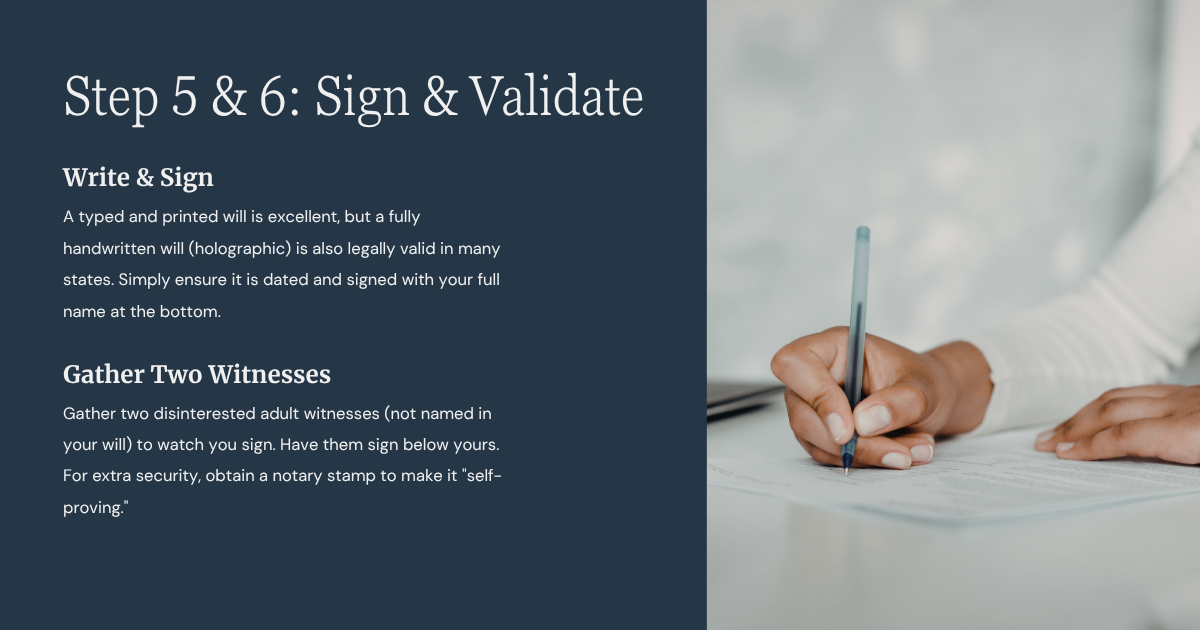
Can you type this up and print it out? Absolutely. But if you want the absolute fastest, zero-cost method, you can write the entire thing out by hand.
In many jurisdictions, a completely handwritten will—known legally as a holographic will—is entirely valid as long as the entire text, the date, and the signature are in your own handwriting.
Whether you type it or write it by hand, the critical piece of the puzzle is that you must sign it. An unsigned will is just a piece of scratch paper. Sign your full name clearly at the very bottom, right below the final sentence of your instructions.
Step 6: Make It Legal with Witnesses
Here is where the magic happens. To make a typed will legally binding, you generally need two witnesses to watch you sign it.
Your witnesses cannot be people who are named in the will. Do not use your spouse, your children, or anyone inheriting your property. Instead, ask neighbors, coworkers, or friends who don’t have a financial stake in the document.
Gather your two witnesses together. Sign the document in front of them. Then, have them sign their names directly below yours, including their printed names, addresses, and the date. By signing, they are simply certifying that you are who you say you are, that you are of sound mind, and that they watched you sign the paper.
While not always strictly required, taking your witnesses to a local notary public to get the document notarized adds an extra layer of armor, making it “self-proving” and saving your family a lot of time in court later.
Step 7: Tell Someone Where It Is
A legal will does absolutely no good if it is hidden in a secret location that nobody can find. You do not need to register it with the state or hide it in a safety deposit box that requires a court order to open.
Put it in a bright, clearly labeled folder. Place it in a secure, accessible spot at home, like a fireproof lockbox or a specific desk drawer.
Most importantly, tell your executor exactly where it lives. Better yet, give them a photocopy or a digital scan of the signed version.
A Simple Act of Love
That’s it. You are done. No endless meetings, no massive legal bills, and no looming clouds of gloom.
By spending just a few minutes putting your wishes in writing, you have created a clear roadmap for the people you care about most. You have protected your kids, secured the future of your pets, and ensured your belongings go exactly where they belong.
More than anything, you have taken the guesswork out of an incredibly emotional time for your family. It is a simple, practical act of love—and you can cross it off your to-do list before lunch today.
