The Silent Gallery of Our Past
We often cross oceans to find history, wandering through the ancient cathedrals of Europe or the ruins of Rome. Yet, some of the most profound and beautiful stories of our collective identity are much closer to home. Across Canada, nestled within our cities and towns, lie “outdoor museums” that hold the keys to who we were and what we valued.
Heritage cemeteries are not places of gloom. They are lush galleries of art and sociology where our ancestors spoke a language of stone. To walk through these gates is to step into a curated landscape designed to tell a story about love, loss, and the building of a nation.
The Victorian Art of Grief
The mid-1800s ushered in the Victorian “Cult of Mourning.” This era transformed the rugged, practical burial grounds of early settlers into park-like “rural cemeteries.” Death was no longer hidden away; it was romanticized through elaborate rituals and intricate art.
This period saw the rise of the garden cemetery, where families would picnic and stroll among the monuments. Every carving was a deliberate choice, a coded message left for future generations to decipher.
A Nation in Its Youth
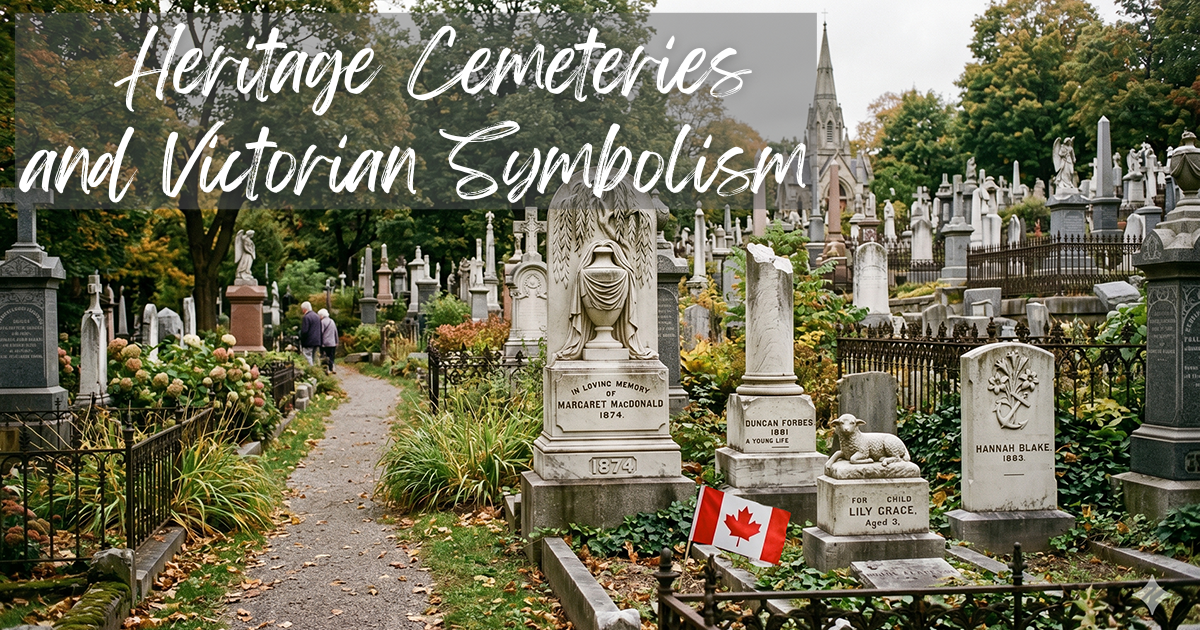
One of the most poignant symbols you will encounter in a Canadian cemetery is the Broken Column. Usually standing as a pillar snapped off at the top, it represents a life cut short.
In the 19th century, this symbol held a heavy weight in a young, developing country. It stands for the breadwinners lost to harsh winters, mothers lost in childbirth, or young men who never returned from the frontier. It is a visual record of the “what ifs” that shaped our early provinces.
The Language of Leaves
Nature was the primary vocabulary for Victorian stonemasons. The Weeping Willow is perhaps the most classic emblem of grief. Its drooping branches perfectly mirror the posture of a mourner. However, it also signifies nature’s enduring presence—a tree that can be cut back and still find the strength to regrow.
Similarly, look for the Ivy or the Grapevine. These climbing plants are rarely just decorative. Because they are evergreen and cling tightly to the stone, they symbolize undying memory and eternal life. They suggest that while the body may fail, the connection to the living remains unbreakable.
Directions of the Soul
The human hand appears frequently, often with a single finger pointing. A Hand Pointing Up is a clear signal of hope for heaven and the belief that the soul has ascended.
Conversely, a Hand Reaching Down—often emerging from a cloud—represents the “Hand of God” reaching down to claim a soul. It’s a subtle distinction that tells us whether the family wanted to emphasize the journey of the deceased or the sovereignty of the divine.
The Canadian Granite and the Maple Leaf
While many symbols were imported from Europe, a distinctly Canadian visual language began to emerge in the late 19th century. One of the most striking nuances is the transition from soft English marble to Canadian Pink Granite.
Quarried from the Canadian Shield, this stone was incredibly difficult to carve, making it a status symbol of Canadian resilience. Look closely at these monuments, and you will often see the Maple Leaf integrated into traditional Victorian wreaths. Unlike the European oak leaf, the Canadian maple leaf was used here to signify a distinct national pride, often seen on the graves of those who felt they had truly built a “New World” home.
Your Invitation to the Past
Every province holds these quiet codes. Whether it is the sprawling hills of Mount Pleasant in Toronto, the historic grandeur of Cimetière Notre-Dame-des-Neiges in Montreal, or the seaside peace of Ross Bay, these sites are waiting to be read.
The next time you pass a heritage cemetery, step inside. To understand these symbols is to finally hear the stories of the generations who built the ground you stand on. The code is there; you only need to look.
