Día de los Muertos: Understanding the Day of the Dead and Why It Matters
Researchers studying bereavement have long noted that cultures maintaining active, communal rituals of remembrance tend to grieve with greater resilience — and few traditions anywhere in the world embody that truth as fully as Día de los Muertos. The Day of the Dead is not a Halloween offshoot or a costume theme. It is a centuries-old practice that does something we in funeral care quietly wish more of our families felt free to do: it keeps the conversation with the dead alive, warm, and full of love. We want to walk you through what this holiday truly is, what its symbols mean, and how to approach it with the respect it deserves.
A Celebration Born from Two Worlds
Día de los Muertos falls on November 1st and 2nd, overlapping deliberately with the Catholic observances of All Saints’ Day and All Souls’ Day. When Spanish missionaries arrived in Mexico centuries ago, they encountered indigenous peoples — including the Aztec — who had honored their dead with elaborate ceremonies for thousands of years. What emerged from that collision of cultures was something entirely its own: a holiday that holds grief and joy in the same hand without forcing either one to apologize for being there.
The core belief is tender and simple. For these two days, the veil between the living and the dead grows thin enough that the spirits of loved ones can find their way home. Families do not mourn — they prepare for company.
The Ofrenda: Building a Welcome Home
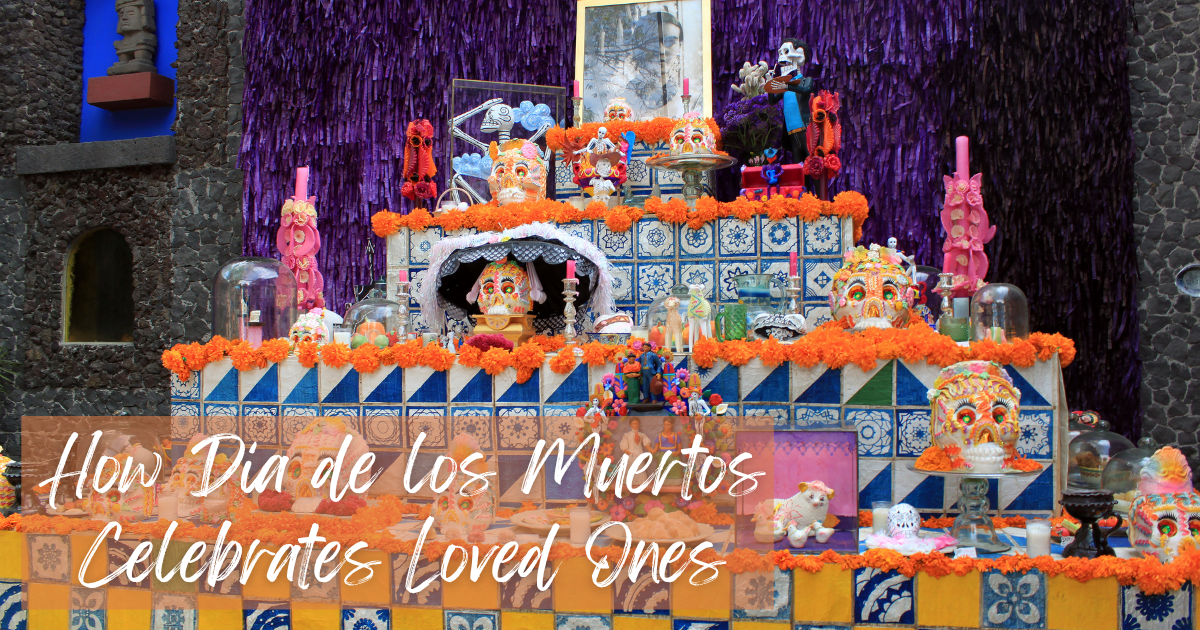
The heart of any Día de los Muertos celebration is the ofrenda — the altar built in the home to guide spirits back and make them feel welcomed. These are not shrines in a distant religious sense so much as deeply personal expressions of love, built by hands that miss someone. An ofrenda typically rises in two to seven levels, and each carries meaning:
- The top level is reserved for religious figures — La Virgen de Guadalupe, a patron saint, or a cross — acknowledging the soul’s spiritual journey.
- The next level honors los angelitos, children who have died. Toys, candy, and small cups of milk welcome them back.
- The lower levels are dedicated to adult relatives, filled with their favorite foods, drinks, photographs, and the personal objects that made them who they were.
Marigolds — cempasúchil — are scattered in brilliant orange trails from the front door to the altar. Their strong fragrance is believed to help spirits follow the path home. Candles light the way. Copal incense purifies the air. Every element has a purpose, and every purpose is love.
The Cemetery Visit: Reunion, Not Mourning
On these days, families travel to cemeteries not to grieve but to gather. Graves are cleaned and decorated with marigolds, candles, and photographs. Families spread blankets, share meals, and spend hours in conversation — with each other and, in their own ways, with the person buried there. Children move freely between the headstones. Music plays. To an outside eye it looks like a picnic in the most sacred possible sense.
We find this profoundly moving, because we know from our own work how much healing happens when people are simply given permission to be near those they have lost — to sit with them rather than retreat from them.
Food, Story, and the Keeping of Memory
Food is not incidental to Día de los Muertos — it is central to it. Families cook the dishes their loved ones cherished in life and place them on the ofrenda so the spirit can enjoy the aroma and essence. Traditional foods include pan de muerto, a soft, slightly sweet bread decorated with bone-shaped dough, alongside mole, tamales, and whatever personal favorites defined the person being remembered.
Sharing stories around the table matters just as much. To say someone’s name, to laugh at their habits, to pass down their recipes — these are the acts that keep a person alive in the truest sense. We see this with our own families constantly: memory, spoken aloud, is one of the most powerful gifts the living can offer the dead.
The Symbols and What They Carry
Día de los Muertos has a visual language all its own. Skulls and skeletons — the iconic calaveras — are rendered in bright colors and playful designs not to frighten, but to disarm. They remind us that death is part of life, not its opposite. Papel picado, delicate tissue paper cut into intricate patterns and strung above the ofrenda, represents the wind and the fragile beauty of existence.
Monarch butterflies hold a special place in the tradition. Their annual migration into Mexico arrives each year around the time of the holiday, and many believe they carry the souls of the departed home for the visit. It is the kind of detail that, once you know it, makes it difficult to watch a migrating butterfly the same way again.
Approaching the Holiday with Respect
As Día de los Muertos has grown more visible in popular culture, so has the risk of reducing it to costumes and decorations stripped of their meaning. We encourage anyone drawn to this tradition to engage with it thoughtfully. Seek out events organized by Mexican and Mexican-American communities. Visit cultural centers or museums that place the history in context. Learn the names of the symbols and what they carry before you use them.
This holiday has survived conquest, colonization, and commercialization because it is rooted in something no outside force can touch: the love families hold for the people they have lost. We recognize that love in our work every single day.
However your own family remembers those you have lost, there is something worth borrowing here — the simple, courageous act of welcoming the memory of the dead back into the room, setting them a place at the table, and letting yourself be glad, truly glad, that they were here.
