
Grief at the Holiday Table: Finding Your Way Through Thanksgiving After Loss
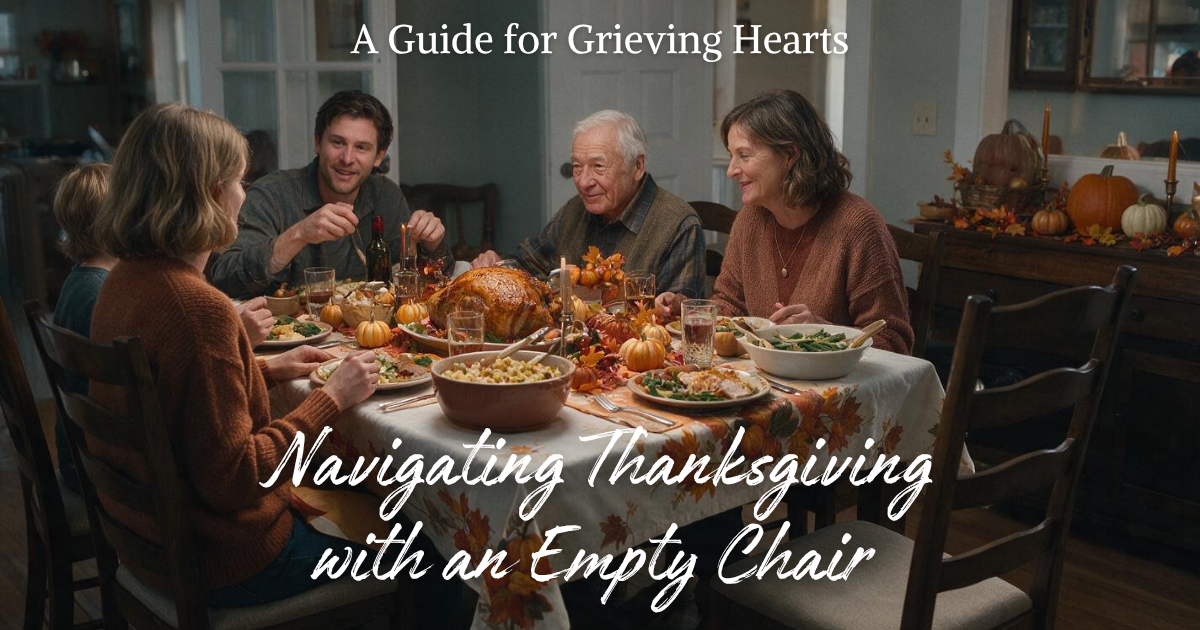
Nearly 2.8 million people die in the United States each year, according to the Centers for Disease Control and Prevention — which means that this Thanksgiving, millions of families will gather around a table with an empty chair where someone beloved used to sit. If you are among them, this is for you. We want to walk alongside you through what may be one of the hardest days of your first year without your person, and offer some honest, practical comfort for the road ahead.
There is something almost cruel about the contrast — the warmth of candles, the smell of familiar food, the sound of laughter — when your heart is carrying so much weight. We see this every year in the families we serve, and we want you to know: what you are feeling is not a sign that something is wrong with you. It is a sign of how deeply you loved.
Grief Doesn’t Pause for Holidays
Holidays have a way of sharpening grief. The very traditions that once brought joy — the same recipes, the same playlist, the same seating arrangement — become sudden, unexpected reminders of absence. Grief researchers sometimes call these “grief bursts”: moments when sorrow arrives without warning, even in the middle of something ordinary like passing the cranberry sauce.
There is no correct way to feel your way through this day. You may feel sadness, anger, guilt, relief, or a strange and disorienting gratitude — sometimes all within the same hour. None of those feelings are wrong. Grief is not linear, and it is certainly not polite enough to take a holiday off.
Before the Gathering: Gentle Preparation
A little honest conversation before Thanksgiving can make the day itself feel less like something to survive and more like something to move through together. A few things worth considering ahead of time:
- Tell people what you need. If you want the gathering to be smaller this year, say so. If you need people not to avoid your loved one’s name, say that too. Most people want to support you — they just don’t know how unless you tell them.
- Decide how you want to honor your person. Some families light a candle at their loved one’s place. Others share a favorite memory before the meal, or cook one of their recipes as a tribute. Having a plan gives grief somewhere to go rather than letting it ambush you.
- Give yourself permission to change the plan. If a tradition feels unbearable this year, you are allowed to set it aside. Skipping something is not betrayal — it is survival, and there is no shame in it.
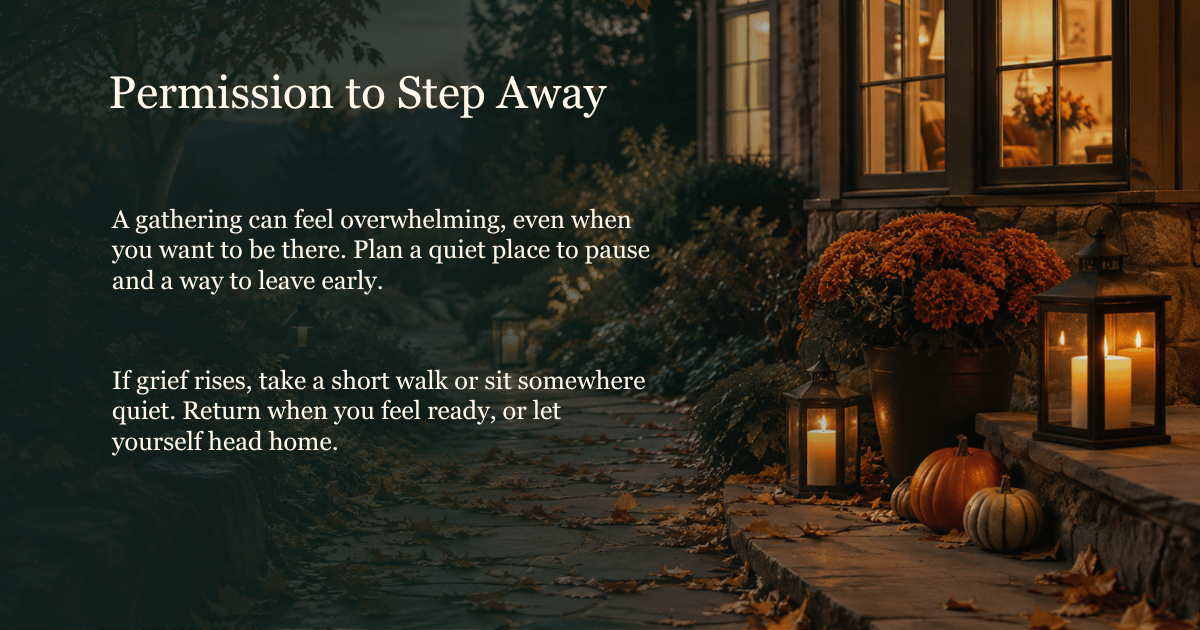
- Have an exit strategy. Know in advance that it is okay to step outside for a few minutes, to leave early, or to spend part of the day quietly alone. Giving yourself that permission ahead of time makes it easier to take it when you need to.
During the Day: Moving Through It
Even with the best preparation, Thanksgiving can hit differently once you are actually in the room. If the weight becomes too much, step away without apology. A short walk, a few minutes of quiet in another room, even a few deep breaths in the car — these are not weakness. They are wisdom.
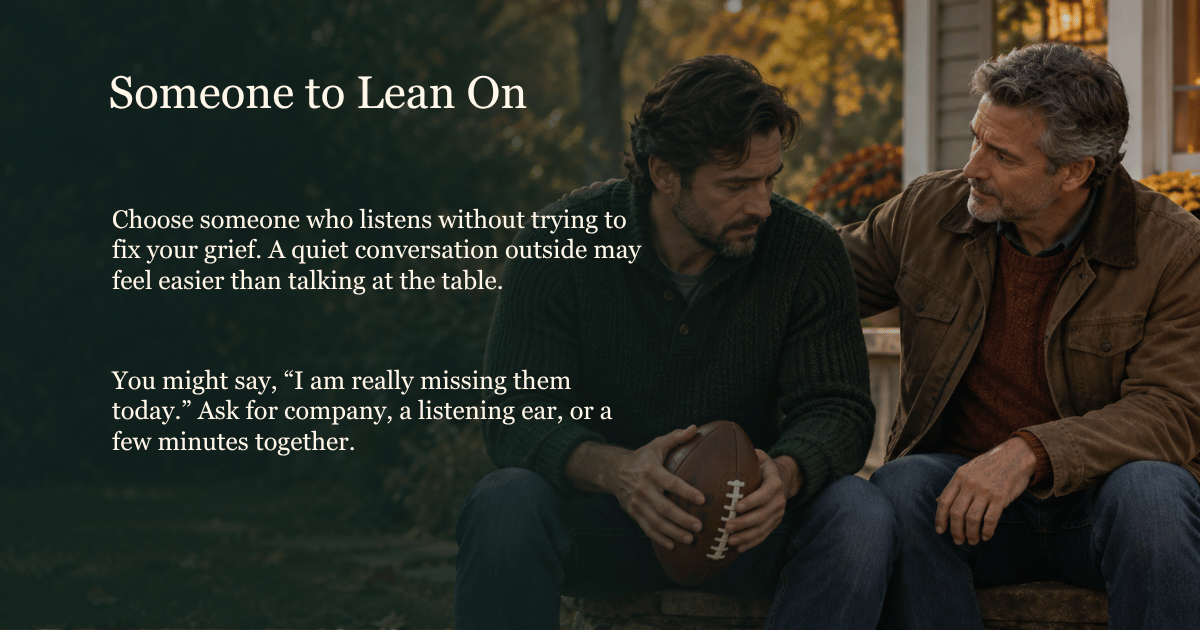
Lean on the people in the room who feel safe. You do not owe anyone a performance of being fine. If someone asks how you are doing and you want to answer honestly, that is allowed. Grief shared is almost always easier than grief hidden.
And if someone mentions your loved one’s name — or if you want to be the one to do it — let that happen. Stories, laughter, even tears at the table are not disruptions. They are honors. The people we lose deserve to be spoken of, especially on days when their absence is loudest.
After the Gathering: Being Gentle with Yourself
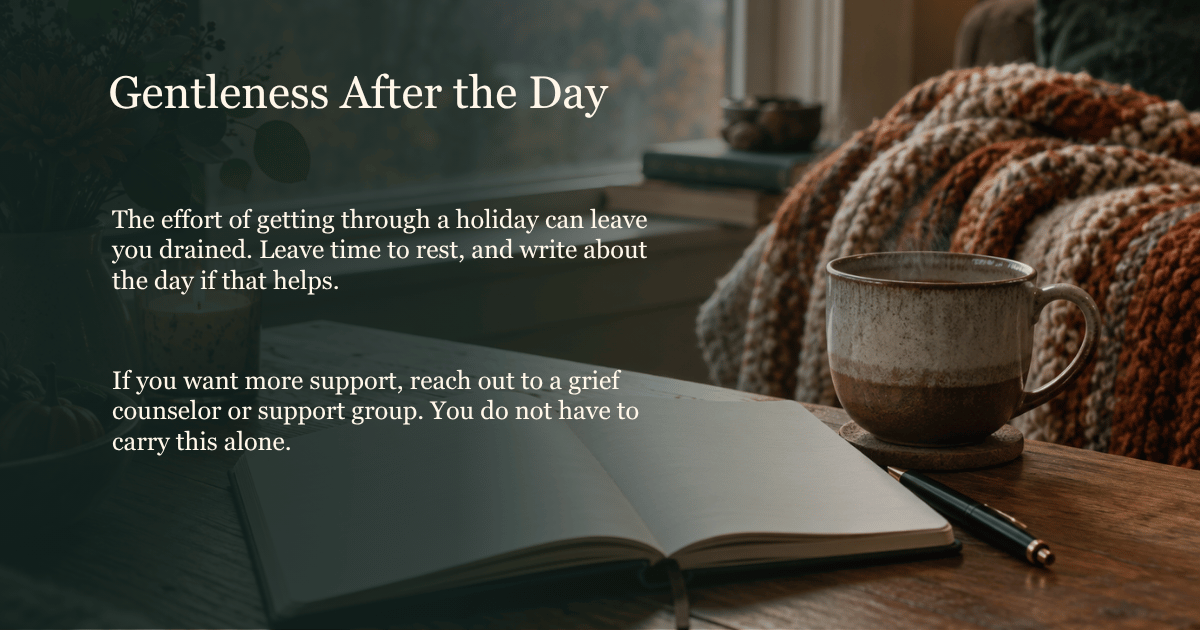
Grief is genuinely exhausting, in ways that go far beyond ordinary tiredness. After the holiday, rest without guilt. If you feel the need to process what you experienced, writing can help — not because journaling fixes anything, but because putting words to feelings has a way of making them a little less overwhelming.
If the grief feels too heavy to carry on your own, please consider reaching out to a grief counselor or a grief support group in your community. There is real, lasting comfort in being with others who understand this specific kind of loss — people who know exactly what it means to set one fewer place at the table.
There is no finish line for grief, and no one should rush you toward one. Healing moves at its own pace, quietly and imperfectly, and that is as it should be. This Thanksgiving, we hope you find at least one moment — however small — where you feel held by the love that surrounds you, and by the love that, no matter what, never truly leaves.
