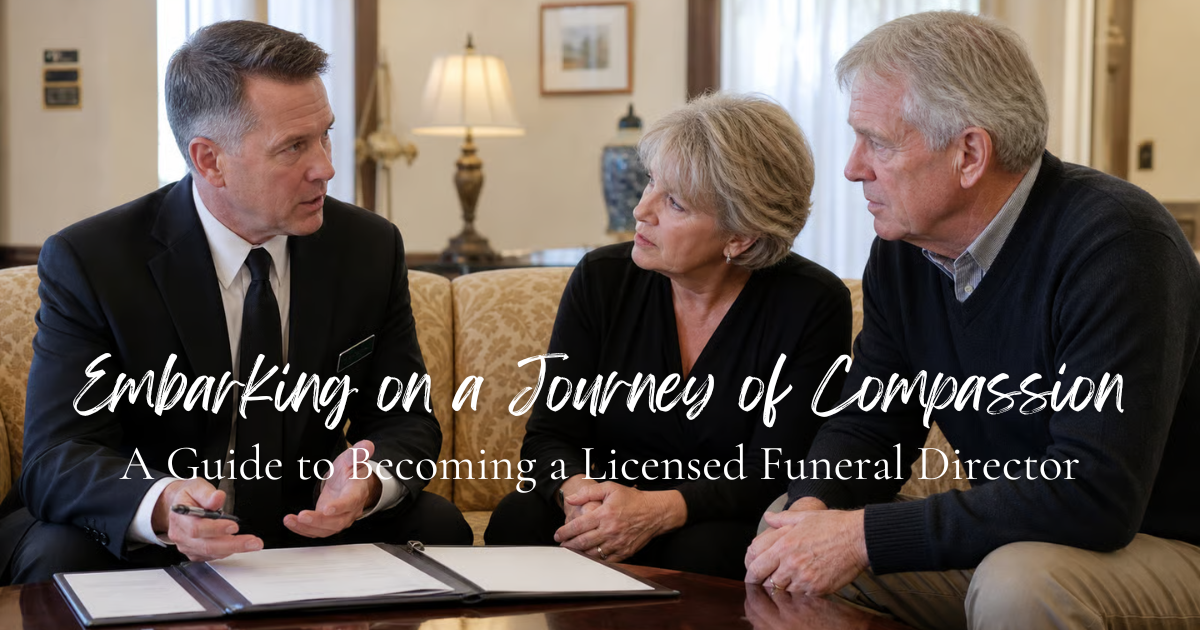
What It Really Takes to Become a Licensed Funeral Director
Nearly one in five Americans says they have experienced the death of a close family member without any guidance on what to do next, according to research cited by the National Funeral Directors Association. Behind every family who finds their footing in that fog is a funeral director who chose this work not because it was easy, but because it mattered. If you are wondering whether this vocation might be right for you, we want to walk you through what it genuinely requires — the personal qualities, the education, and the licensing process — so you can make that decision with open eyes and a full heart.
The Qualities That Set a Good Funeral Director Apart
We will be honest: the technical skills of this profession can be taught. What is harder to teach — and what no licensing exam can measure — is the kind of person you bring into the room with a grieving family at two in the morning.
Empathy That Goes Beyond Sympathy
There is a meaningful difference between feeling sorry for someone and truly sitting with them in their pain. Empathy means you do not rush a mother who needs to talk about her son for the fourth time that afternoon. It means you notice when someone is holding everything together in public and you quietly give them a moment to fall apart. Without that quality at your core, the rest of the work feels hollow — to you and to the families you serve.
Calm, Clear Communication
Grief scrambles people. They forget what they just agreed to. They ask the same question three times. They need information delivered slowly, plainly, and without judgment. A funeral director who can hold steady in those conversations — listening as much as speaking — becomes an anchor when everything else feels unsteady.
Quiet Resilience
This work is physically demanding and emotionally cumulative. You will carry difficult things home with you sometimes. The directors who last and thrive are those who have honest self-awareness, good boundaries, and a support system of their own. That resilience is not toughness — it is knowing how to care deeply without being consumed.
The Education You Will Need
Most states require at minimum an associate degree in funeral service or mortuary science, though some now require a bachelor’s degree. Accredited programs — look for those approved by the American Board of Funeral Service Education — typically run two years and cover a wide range of subjects, including:
- Embalming and restorative art
- Anatomy and pathology
- Grief counseling and psychology
- Funeral service law and ethics
- Business management and accounting for funeral homes
That classroom foundation matters, but it only goes so far. The most formative education happens inside an actual funeral home — watching how an experienced director reads a room, adjusts a conversation, or handles an unexpected complication without letting a family feel the disruption. If you can find part-time or entry-level work at a funeral home while you are still in school, take it. Those hours are irreplaceable.
The Licensing Process, Step by Step
Licensing requirements differ by state, so the first thing we always tell aspiring directors is to look up your state’s specific rules through its funeral regulatory board. That said, the general path looks like this.
Complete Your Degree
Finish an accredited funeral service or mortuary science program. Make sure the school is recognized by your state’s licensing board before you enroll — not all programs qualify everywhere.
Pass the National Board Examination
The NBE, administered by the International Conference of Funeral Service Examining Boards, is accepted by most states as part of the licensing requirement. It covers two major areas: funeral service arts and sciences (including embalming) and funeral service social sciences (including law, ethics, and grief). Preparation takes real study — treat it accordingly.
Serve Your Apprenticeship
Nearly every state requires a supervised apprenticeship under a licensed funeral director. The length varies — typically one to three years — and this is where your classroom learning becomes professional practice. Think of it less as proving yourself and more as absorbing everything you can from someone who has already navigated the situations you have only read about.
Apply for Your License
Once your education, examination, and apprenticeship requirements are met, you submit your application to the state licensing board. After approval, your license must be renewed regularly, and most states require continuing education to keep it current. That ongoing learning is not a burden — it is how we stay genuinely good at what we do as practices and community needs evolve.
A Calling Worth the Work
There are careers, and then there are callings. Funeral service sits firmly in the second category. The path to a license is not short, and the work itself will ask more of you on some days than you expect. But when a family looks at you with relief — when they tell you that you made an unbearable week somehow bearable — there is nothing quite like it. If that kind of purpose speaks to you, this profession will meet you where you are.
