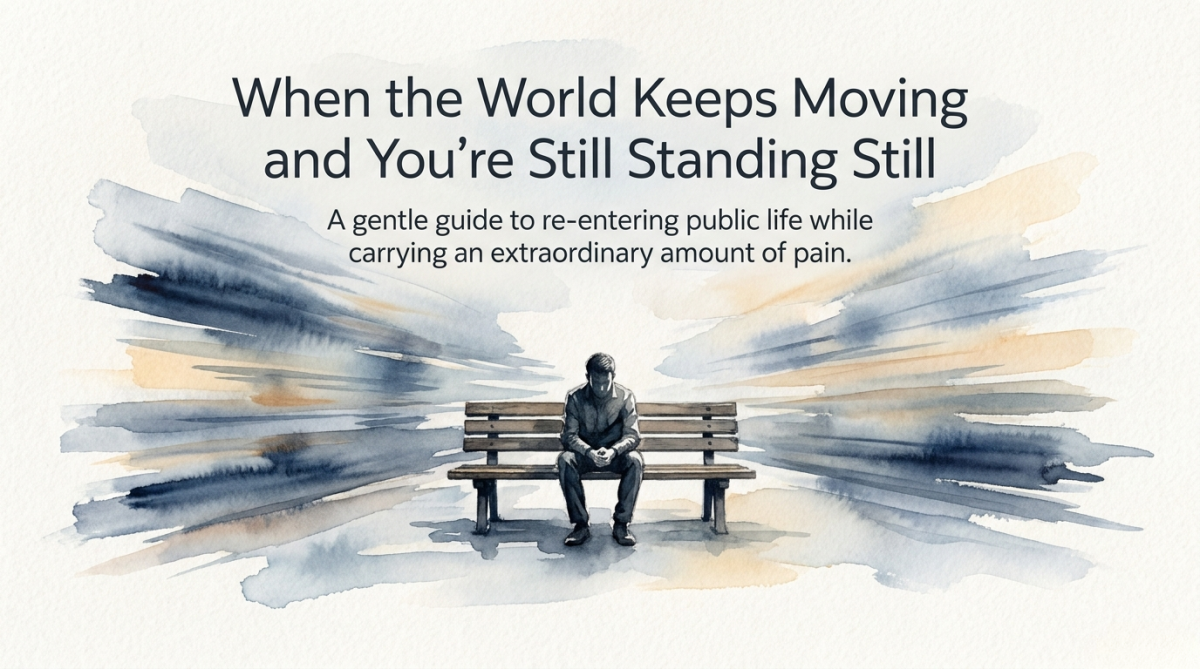
Grief researchers estimate that most bereaved people return to work or public life within one to two weeks of a loss — long before the emotional weight has even begun to lift. If you’ve ever stood in a grocery store aisle, frozen, because a well-meaning stranger noticed your red eyes and said something that cracked you open all over again, you already know exactly why that gap matters. This article is for anyone stepping back into ordinary life while carrying an extraordinary amount of pain — and it’s meant to give you real, practical ways to protect your peace while doing it.
Why Re-Entry Feels So Disorienting
There’s something almost surreal about the world’s indifference to your loss. The produce section is still stocked. Your coworkers are still talking about weekend plans. The traffic is still terrible. And yet everything inside you has shifted permanently. That dissonance — between the world that kept moving and the self that stopped — is one of the most quietly painful parts of early grief.
What catches so many of our families off guard is that it isn’t the big moments that undo them. It’s the small, unpredictable ones: a song in the checkout line, a coworker who uses the wrong tense and says “is” instead of “was,” or someone who simply asks, “How are you?” without realizing what they’re asking.
What People Mean When They Say the Wrong Thing
Most people are not unkind — they are simply undertrained in loss. When someone says “Everything happens for a reason” or “At least they’re not suffering,” they are not trying to minimize your pain. They are trying to escape their own discomfort with death, and they are reaching for the only language they know.
Understanding that doesn’t always make those words land more softly. But it can take some of the sting out, knowing the impulse behind them is usually love — clumsy, imperfect, very human love. We’ve sat with thousands of families over the years, and one thing we’ve heard again and again is how much it helps just to name what’s happening: people mean well, and they still get it wrong, and both of those things are true at the same time.
Preparing Yourself Before You Walk Out the Door
A little preparation goes a long way. Before returning to public spaces or the workplace, it helps to think through a few things so you’re not making decisions in the moment while you’re already overwhelmed.
- Have a short answer ready. When someone asks how you’re doing, “I’m getting through it, thank you” is a complete and honest answer. You don’t owe anyone your full story.
- Identify a safe person at work. Let one trusted colleague know where you are emotionally so you have someone to check in with if a hard moment hits.
- Give yourself permission to leave. If a gathering or errand becomes too much, leaving is not weakness. It is wisdom. Drive yourself when you can so that option is always available.
- Plan your route through difficult spaces. If a certain store aisle or a particular seat in a meeting room carries a memory, it’s okay to avoid it for now.
- Lower the bar for what counts as a success. Showing up at all is enough. Getting through one hour is enough.
In the Moment: What to Do When It Gets Hard
Even with preparation, grief has a way of arriving uninvited. When emotion wells up in a public place, give yourself five seconds before responding to anyone. A slow breath. A brief “excuse me.” Stepping into a restroom, your car, or even a quieter part of the building is not avoidance — it’s self-care in the most literal sense.
You are never obligated to perform okayness for someone else’s comfort. If a conversation becomes too much, it is perfectly gracious to say, “I appreciate you thinking of me. I’m not quite ready to talk about it yet.” Most people will respect that more than you expect.
For the Workplace Specifically
Returning to work carries its own particular weight. We’d encourage anyone going back to speak briefly with a manager or HR contact beforehand — not to share everything, but to establish that there may be moments when you need to step away. Many workplaces are more accommodating than people expect, especially when asked with clarity rather than apology.
Grief also affects concentration, memory, and decision-making in ways that can feel alarming if you don’t know to expect them. This is a well-documented phenomenon sometimes called “grief brain,” and it is temporary. Be patient with yourself. Write things down. Ask for deadlines to be confirmed in writing. These are not signs of weakness — they are honest adaptations to an honest reality.
The Longer View
Re-entering the world after loss is not a single event. It happens in layers, over weeks and months, and there will be days that feel like you’ve gone backwards. That is normal, and it doesn’t mean you’re doing grief wrong.
The world will keep moving — it always does — and slowly, in your own time, you will find ways to move alongside it again without leaving your loved one behind. They go with you, in every room you walk back into.
Free guide: If you would like a little more help with this topic, our free guide, When the World Keeps Moving and You’re Still Standing Still, offers practical information you can keep and refer back to as you make decisions.
